Dr. Deb Cehak is a registered clinical counsellor in British Columbia, Canada, with Master’s and Doctoral degrees in adolescence, and trained as a narrative therapist and separation and co-parenting counsellor. Deb is a divorced mother of five children, has experienced resist/refuse dynamics personally, and sees the development and effects of resist/refuse on families in her practice, both in the beginning stages of this dynamic and years into it.
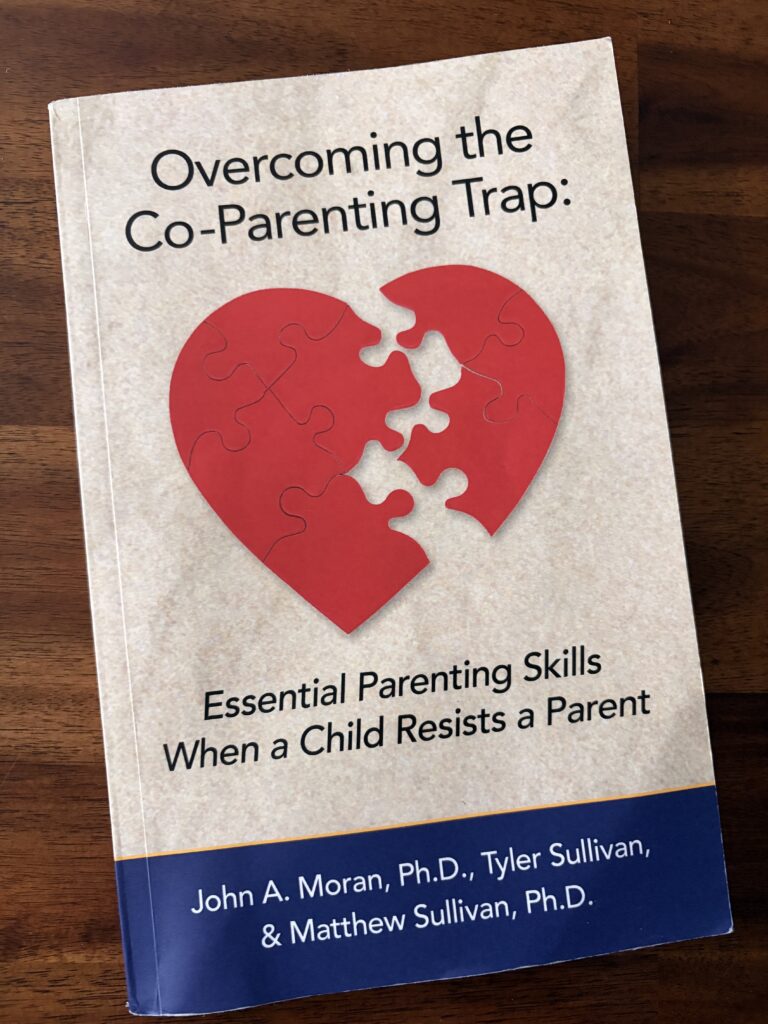
Resist/refuse dynamics are a heart-breaking circumstance in many separated families. In an effort to raise awareness and share research and experience on the topic for separated parents, extended family, friends, our communities, and all practitioners working with separated families, this review highlights the main points of Overcoming the Co-Parenting Trap: Essential Parenting Skills When a Child Resists a Parent (2015) by John Moran, Tyler Sullivan, and Matthew Sullivan. It includes: an overview of the problem, ideas to consider for the resisted parent, the preferred parent, understanding the co-parenting trap, why the co-parenting trap exists, and how to overcome it.
Overview of the Problem
Resist/refuse can develop rapidly. Risk for resist/refuse increases when separation is very emotional and conflictual, when children are involved in the martial conflict even subtly or unconsciously, when the separation is challenging, embarrassing, or humiliating, when litigation is involved, and when a parent introduces a new partner. The main theme in these situations become: the resisted parent is not safe.
To Consider Regarding the Resisted Parent:
- Aim for positive interactions: the resisted parent will not have success with discipline, supporting research that parents must connect before they can direct (Dukes, 2017; Siegel, 2016; Van Geffen, 2026).
- Plan activities around the child’s interests and plan activities that require less interaction (No dinners! Dinners are too close in proximity with too much interaction). Give the child a few options so they have choice, but not too many options so the choice is overwhelming. The message is: time spent together is what is important, not the activity.
- Expect resistance and plan accordingly: the resisted parent is in a very tricky situation with high stakes and significant emotion. Resisting children can be rude, stubborn, defiant, and disrespectful. Be ready for resistance and plan for how to respond (the book compared these situations to first responders and their need to train and plan for crises).
- Talking about the problem may make the situation worse, but it may not, as each relationship is unique.
- Acknowledge negative emotions: listen to where the child is coming from and respond with understanding and care. Do not argue what the ‘truth’ is. Listen for the message underneath the negative emotion. If an apology is appropriate, both the resisted and preferred parents can apologize for their part in the child’s resistance. Everyone contributed.
- The child often feels the resisted parent wants too much too soon and then feels the parent is not listening.
- Expect progress to be in baby steps.
- The idea is for the child to receive messages of care and love, and that the resisted parent loves and will always be there for them, without feeling the need to respond.
To Consider Regarding the Preferred Parent:
- The preferred parent often has the following concerns for the child: abuse, the stress of being in contact with the resisted parent, the belief that children deserve a safe and carefree childhood, and/or that their co-parent does not know how to parent appropriately- these concerns need to be addressed with a professional.
- The preferred parent also often holds the resisted parent accountable for the resistance of the child, which is short-sighted, as the resistance is “rooted in years of marital disharmony and co-parenting disagreements” (Moran et al., p. 48).
- The child picks up on the unconscious messaging of the preferred parent. For example, the child will register if the preferred parent pays more attention when the child says something negative about the resisted parent.
- Not intervening leaves the child with painful and lasting memories of the dispute.
- Without clear messaging from the preferred parent (in words and actions), the child will create their own assumptions and beliefs.
- Even mild ambivalence from the preferred parent regarding the child spending time with the resisted parent gives the child the impression they have a choice to connect or not and additionally, it places the child in the middle of the parent conflict.
- How to respond to the child’s refusal of the preferred parent:
- Treat time with the resisted parent as a critical event: a doctor’s appointment, school, time with extended family. Express that time with the resisted parent is not optional- this is a “matter of supreme importance” (Moran et al., 2015, p. 49).
- Respect and acknowledge child’s perspective, and challenge it.
- The message is: this is awkward, challenging, emotional, and both parents love you and this can get better with time.
- The preferred parent has the leverage; they NEED to use it.
- The sooner the preferred parent establishes that a relationship with the resisted parent is not optional, the sooner this debate ends. If a child refuses, they may lose privileges such as: grounding, cell phone use, etcetera.
- Do NOT send a child to counselling alone or with the resisted parent only. This is ineffective because it reinforces the idea that this is a parent/child problem instead of a parent/family systems problem; additionally, it makes child responsible for co-parenting conflict.
Children of separation and divorce need their parents to compartmentalize negative feelings of each other so the children perceive (what the parents believe they are doing is irrelevant; what the children perceive is everything) they have two supportive parents. Children feel and express relief when an adult (whether a parent, divorce coach, or judge, for example) takes over parent contact decisions- it relieves the child of the burden of responsibility. Children who resist a parent and are supported (consciously and explicitly or unconsciously and implicitly) in the resistance believe it is okay to be defiant and withdraw from interpersonal problems. Later in life, these children can feel guilt, shame, and regret from resisting. Three decades of research demonstrates that resisting and not having contact with a parent has a significant impact on these children’s future forming intimate attachments: “Loss of relationship with a parent can negatively impact the child’s long-term ability to successfully negotiate the challenges of romance and having a family” (Moran et al., 2015, p. 44).
Understanding the Co-Parenting Trap
Upon separation, emotions are elevated. With many co-parents, the intensity of feelings settle two to three years post separation. Over time, 25-30% parents co-parent co-operatively, more than half parallel co-parent meaning there is emotional disengagement, low conflict & low communication, and 20-25% have high conflict defined by poor communication, high distrust, low cooperation, and failed decision-making. Interestingly and worth highlighting, parents caught in the co-parenting trap believe and are often confident their words and actions are reasonable, but the co-parenting trap brings out the worst in everyone.
How Conflict Escalates
Step 1. Normal every day conflict.
Step 2. Fluctuation between competition and cooperation. Tension mounts and the goal becomes trying to convince or win instead of clarifying misunderstandings.
Step 3. Parents lose hope for cooperation and finding resolution. Interactions become hostile. Negative stereotypes develop.
Step 4. Defensiveness and counter-arguments replace listening and understanding.
Step 5. Fear and threats lead parents toward wanting total control.
Why and How the Co-parenting Trap Persists
Moran et al., (2015) introduce four concepts and definitions that maintain conflict in separation:
Selective perception: filtering information to suit a narrative.
Self-fulfilling prophecies: when a parent acts in a way that provokes the other parent to act in expected ways and then gets upset when the parent acts in the expected ways.
Passive aggressive hostility: breaking off communication when conflict is encountered, which then creates and maintains misunderstanding because not enough information is provided.
Stereotyping: oversimplifying the cause of conflict and developing fixed beliefs about the co-parent.
Overcoming the Co-parenting Trap:
Figuring out who started the conflict or who did what wrong is not helpful as “most behaviour is too complicated to identify simple causes” (Moran et al., 2015, p. 68). As well, inexperienced practitioners can increase a child’s resistance and make the co-parenting trap worse. Fortunately, research offers some ideas for how to put an end to the co-parent trap. What can be helpful for negotiating co-parenting agreements include:
Setting an agenda to avoid surprises
Committing to being amicable
Seeking to understand
Focussing on what is needed to move forward
Avoiding lecturing
Responding to attacks and criticism with acknowledgement and concern
Forgiveness
Seeking professional help, as it provides a neutral and more objective space
CONCLUSION
Few parents are prepared for resist/refuse dynamics upon separation and are thus unprepared and unequipped when it happens. Resist/refuse can happen suddenly and due to the longterm negative effects on children, requires immediate intervention and support from knowledgeable and experienced professionals. This review of Overcoming the Co-Parenting Trap: Essential Parenting Skills When a Child Resists a Parent is written directly and concisely with the aim to reach and educate as many folks, both personally and professionally effected by resist/refuse, as possible. However, if this review piques further interest, the book is also a concise, brief, and a worthwhile read.
If you have questions, please reach out.
Reference List
Moran, J., Sullivan, T., & Sullivan, M. (2015). Overcoming the Co-Parenting Trap: Essential Parenting Skills When a Child Resists a Parent. Overcoming Barriers Inc.
Dukes, T. (2017). The present parent handbook: 26 simple tools to discover that this moment, this action, this thought, this feeling is exactly why I am here. Familius.
Siegel, D. (2016). No-drama discipline: Exercises, activities, and practical strategies to calm the chaos and nurture developing minds. Pesi Publishing & Media.
Van Geffen, M. (2026). Parenting a spicy one: A compassionate guide for raising a deep-feeling and wonderfully strong-willed kid. Revell, a division of Baker Publishing Group.